Updated: 2/06/2010


Welcome to...

by Healthcare Business Specialists

Email: la_vita_nouva@hotmail.com

Suite 214, 502 Shadow Parkway

Chattanooga, TN  37421

Tele: (423) 243-6185

Welcome to the Healthcare Business Specialists home page dedicated to Rural Health Clinics (RHCs).  We have designed this site to provide the latest information on rural health clinics and information on Rural Health Clinic Update and RHC Boot Camp seminars. The seminars cover Medicare cost reporting, billing, annual evaluations, certification, and the operation of  RHCs as certified by Medicare under Public Law 95-210.  We hope that you find the website helpful to you and please let us know if there is something we can do to make the website more useful.

 Healthcare Business Specialists is a Chattanooga, Tennessee-based consulting firm which specializes in rural health clinic reimbursement and prepares rural health clinic cost reports, annual evaluations, Quality Improvement plans, and RHC startups.  Mark R. Lynn is trained as a certified public accountant and has over 23 years experience in the healthcare field with almost 15 years of experience devoted almost exclusively to rural health clinics.  We have been conducting rural health clinic seminars for over 10 years and each year over 80% of our attendees have been to one of our seminars in the past. 


What is a Rural Health Clinic?

The rural health clinic (RHC) program was established in 1977 to address an inadequate supply of physicians who serve Medicare and Medicaid beneficiaries in rural areas. The program provides qualifying Clinics located in rural and medically underserved communities with payment on a cost-related basis for outpatient physician and certain nonphysician services. For RHC purposes, any area that is not defined by the U.S. Census Bureau as urbanized is considered non-urbanized. RHCs are located in areas that are designated or certified by the Secretary of the Department of Health and Human Services as Health Professional Shortage Areas (HPSA) or Medically Underserved Areas (MUA). 

As of March, 2009 there are 3,751 rural health clinics in the United States. The major advantage that rural health clinics have over regular physician practice is an increase in both Medicare and Medicaid reimbursement. In fact, the increases in Medicaid reimbursements can be dramatic. For this reason; surprisingly pediatric clinics are the specialty that has the largest increase in reimbursement when converting into a rural health clinic. Just about all of rural America is eligible for RHC status as of now. This is changing with proposed regulations that would limit the areas that RHCs could be located. If you are interested in becoming a rural health clinic don’t wait to convert as final regulations limiting your ability to become a rural health clinic could be issued at any time. Now is the time to act; if you want to enjoy the enhanced reimbursement that a rural health clinic offers. 

If you are interested in becoming a rural health clinic; please review this summary document and if it is something that interests you contact us at (423) 243-6185 or la_vita_nouva@hotmail.com.


http://www.cms.hhs.gov/MLNProducts/Downloads/rhcfactsheet.pdf


Some RHC Billing Links

We have been searching the internet for the best information for our upcoming RHC Update Seminars and we are incorporating everything we learn in our seminars, notebooks, and CDs. We are completely updating all our manuals on Cost Reporting, Billing, and our RHC Update Seminar Notebooks. If you want to order them the cost is $100 and each includes a CD with all the materials in an easy to find format. Here are a few of the most helpful links I have found so far:

 https://www.highmarkmedicareservices.com/calendar/parta/webinar/pdf/web-handouts-021010.pdf

This first link is to a Highmark Medicare Services Webinar that will be conducted on February 10, 2010. It sounds like a good idea to sign up for this one if you have someone new to billing or need to train someone. This looks like invaluable training for your staff.  To register for the seminar called Introduction to Medicare Part A  which will start at 10:00 am Eastern ST on February 10, 2010 follow this link:

https://www.highmarkmedicareservices.com/calendar/parta/webinar/index.html

Also, if you like the information above; the link below has an Update that Highmark presented on January 12th, 2010 that is filled with valuable information for rural health clinics. Here is the link:

https://www.highmarkmedicareservices.com/calendar/parta/pdf/tc-handouts-011210.pdf

This one is a little old; but if you are fighting with your Medicare Advantage plans it never hurts to be able to whip out a CMS memorandum supporting your position that you should be receiving your cost per visit instead of the Medicare fee schedule. Here is the link:

http://www.narhc.org/uploads/pdf/cms_rhc_clarification_pffs_payments.pdf

Next is a link to the Missouri Rural Health Clinic Association website. They have a transcript from the December, 2009 meeting with Cahaba. Cahaba answers some billing questions; however, is pretty inconclusive on most of the questions. Hopefully, we can start getting something in writing on how RHCs will get paid and how to get Medicare to pay when they are the secondary payor.

http://www.marhc.org/Intercall%20Transcript%20%282%29.pdf

Trailblazer Health Enterprises, LLC updated their UB-04 RHC billing examples on January 28, 2010 and provides an excellent example of how the UB-04 should be completed for a number of situations including billing on-site off-site, home visit, covered Part A SNF visit, non-covered Part A SNF visit, psychiatric, two visits, Medicare Secondary Payer (MSP) conditional, MSP liability conditional and MSP primary paid.

http://www.trailblazerhealth.com/Publications/Job%20Aid/RHCUB04BillingExamples.pdf


Most Provider-Based Rural Health Clinics Excluded from

 Electronic Medical Records Stimulus Payments

To read an article regarding the proposed Electronic Stimulus payments and the possible exclusion of most provider-based rural health clinics follow the link to the National Rural Health Association website to the article posted on February 1st,  2010.

http://h184435wp.setupmyblog.com/2010/02/cms-proposed-rule-excludes-most-provider-based-clinics/

Obama's Proposed Budget is a Mixed Bag for Rural Health

Here is an article on the President's budget as it relates to rural health. There is $5 million in grants to states to help federally qualified health centers and rural health clinics transition to a prospective payment system for the Children's Health Insurance Program and certification funding is increased so as to allow the surveyors to inspect clinics on a 6 six year cycle instead of the current every 11.5 year funding.

http://www.healthleadersmedia.com/page-2/COM-245925/Obamas-Proposed-Budget-is-a-Mixed-Bag-for-Rural-Health

Extension of the 2009 Poverty Guidelines until at Least March 1, 2010

On December 19, 2009, the President signed the Department of Defense Appropriations Act, 2010 (Pub. L. 111-118), which included a provision affecting the poverty guidelines. Section 1012 of the law states that:

Notwithstanding any other provision of law, the Secretary of Health and Human Services shall not publish updated poverty guidelines for 2010 under section 673(2) of the Omnibus Budget Reconciliation Act of 1981 (42 U.S.C. 9902(2)) before March 1, 2010, and the poverty guidelines published under such section on January 23, 2009, shall remain in effect until updated poverty guidelines are published.

 http://aspe.hhs.gov/poverty/09extensionfedreg.shtml


The 2009 poverty guidelines figures that will remain in effect are given below.

The 2009 Poverty Guidelines for the
48 Contiguous States and the District of Columbia

Persons in family

Poverty guideline

1

$10,830

2

14,570

3

18,310

4

22,050

5

25,790

6

29,530

7

33,270

8

37,010

For families with more than 8 persons, add $3,740 for each additional person.


2009 Poverty Guidelines for
Alaska

Persons in family

Poverty guideline

1

$13,530

2

18,210

3

22,890

4

27,570

5

32,250

6

36,930

7

41,610

8

46,290

For families with more than 8 persons, add $4,680 for each additional person.


2009 Poverty Guidelines for
Hawaii

Persons in family

Poverty guideline

1

$12,460

2

16,760

3

21,060

4

25,360

5

29,660

6

33,960

7

38,260

8

42,560

For families with more than 8 persons, add $4,300 for each additional person.


SOURCE:  Federal Register, Vol. 74, No. 14, January 23, 2009, pp. 4199–4201

Medicare Physician Fee Schedule Cuts Delayed

On December 16, 2009, the House of Representatives approved a short-term delay in looming Medicare physician fee schedule payment reductions caused by the application of the controversial sustainable growth rate (SGR) formula to the annual fee update.  Specifically, the House version of H.R. 3326, the Department of Defense Appropriations Act for 2010, includes a provision that freezes Medicare rates at currents levels for January and February 2010, in lieu of the 21.2 percent cut scheduled to go into effect January 1, 2010

Medicare Eliminates Use of Consultation Codes

In the 2010 final Medicare Physician Fee Schedule the Centers for Medicare and Medicaid Services (CMS) announced that Medicare will no longer recognize consultation codes for Medicare Part B fee for service payment. CMS directs providers to report other evaluation management (E/M) codes in lieu of the consultation codes. In place of the consultation codes, CMS increased the work relative value units (RVUs) for new and established office visits, increased the work RVUs for initial hospital and initial nursing facility visits, and incorporated the increased use of these visits into the practice expense (PE) and malpractice calculations. CMS also increased the incremental work RVUs for the E/M codes that are built into the 10-day and 90-day global surgical codes. 

RHC Billing Seminar in Hilton Head on July 16, 2010

February 2, 2010: We will be conducting a rural health clinic billing seminar on July, 16, 2010 at the Holiday Inn Oceanfront in Hilton Head, South Carolina. The seminar will be held from 9:30 am to 4:00 pm and will cover rural health clinic billing for independent and provider-based RHCs.  The price for the seminar is $200 and if you would like the RHC Billing Workbook, the price is an additional $100.00. We will provide more information as we get the agenda finalized. An update on our RHC Update seminars:

 In Columbia, Marsha Marze of the South Carolina Office of Rural Health will provide an update on information specific to rural health clinics in the area.

In Indianapolis, Marie Newlin of Medmate will host the seminar at their offices and will provide an update regarding their software and integration with Cahaba.

In St. Louis, Glen H. Beussink, Director of Clinic Development & Research will provide an update on the Electronic Medical Records Stimulus Payments and the current status of those regulations.

To find out more information about the seminars scroll down on this page or clinic the 2010 Seminars link to register online.

Medicare Coding and Payment Trends

 Rural Health Clinics tend to not worry as much about coding as they should due to Medicare and Medicaid paying the same cost per visit regardless of the code; however, the proper assignment of HCPCS/CPT codes will lead to more accurate and in most cases improved overall reimbursement due to an improvement in collections of copayments. Most RHCs dramatically under code as compared to physician offices that are not RHCs. The following table is derived from the fiscal year 2008 Part B Physician/Supplier data from CMS.  The first column has the Established Office patient codes, the second column has the average Medicare allowable charge (not the actual charge, but, the Medicare allowable), and the third column has the percentage that each established office code is used in comparison to the total established office codes.  The average Medicare allowable per visit was $66.70 for 2008 for physician offices. (Divide Total Medicare allowable charges by total established office encounters.)


HCPCS/CPT Code

Average Medicare

Allowable

Charge


Percentage

Of

Total


99211

$19.25

4.3%

99212

$35.76

9.7%

99213

$58.23

48.9%

99214

$88.88

33.1%

99215

$120.03

4.0%

 If you think your clinic is not coding correctly, The American Academy of Family Physicians has a tool that enables physicians to easily compare their coding frequencies with one another and with national benchmarks. Here is the link to download the Excel worksheet: 

http://www.aafp.org/fpm/20070400/codingfrequencycomparison.xls 

In fact there are over 150 free tools in the FPM Toolbox related to physician management, coding, and administration. Here is a link to the tools: 

http://www.aafp.org/online/en/home/publications/journals/fpm/fpmtoolbox.html#Parsys1990

 Many of the tools are downloaded and are included on the RHC Update Seminar CD and are printed in the RHC Update Seminar Notebook.

Average Charges

Average charges in all physician offices are increasing at a dramatic rate; however, rural health clinics continue to lag behind other providers as reflected in a 1.2% increase in the most recent RHC reimbursement cap (from $76.84 in 2009 to $77.76 in 2010). The RHC rate increase is directly tied to the Medicare Economic Index which is influenced by provider charges. According to a presentation at the NARHC annual meeting in 2009 the average charge per visit for RHCs was $101 for Part A services. (This excludes services billed to Part B including laboratory and technical components.)

One easy way to determine if your Medicare charges are reasonable is to take the P S and R report that is used to prepare your RHC cost report and divide total Medicare charges by total Medicare visits. This number represents the average charge per Medicare visit (excluding services billed to Medicare Part B). This number should exceed $100 per visit and the most recent cost report I prepared has an average Medicare charge of $144 for 2009.  Charges will become more and more important as long as Medicare continues to increase the Medicare deducible ($155 in 2010) and RHCs are not subject to Medicare limiting charges. Keep in mind that this significant advantage is being taken away in the proposed RHC regulations published June 27, 2008 in which case RHC collections will be limited to their cost per visit, or the Medicare maximum cost per visit whichever is less. 

While it is difficult to obtain charge information from competitors due to FTC rules regarding price-fixing; data or price analyzers from companies such as Ingenix or St. Anthony’s can be invaluable in helping rural health clinics to establish fair and reasonable charges. 

Payment Add-ons for Physician offices

 One of the most common areas of questions related to RHC reimbursement relates to payments additions that Medicare offers physicians. The question is always “As a rural health clinic do I qualify for the add on payment?” and unfortunately the answer is a resounding “no” in most cases. Let’s look at three of the most common add-ons in some detail. 

Health Professional Shortage Area (HPSA)

Bonus Payments (10%) 

RHCs are not eligible for this additional payment of 10% on their RHC cost-based business that is billed to Medicare Part A. However, services billed to Part B may be eligible. The HPSA payments are administered through the MAC, which may be the same or different than the RHC intermediary. It depends on which region you are in.  When filing the CMS 1500 claim, you must include: 

1) the name, address and zip code of the location where the service was  rendered

2) your NPI number

3) Code AQ in the modifier field 

The 10% bonus will be paid to you in a quarterly remittance check by the MAC.  The bonus is only for geographic HPSA's and is available to any physician billing Medicare for Medicare eligible patients. Eligible services are professional services such as hospital and nursing home visits.  Medicare Advantage and Tricare plans pay HPSA bonuses as well.[1] 

Physician Quality Reporting Initiative (PQRI) and E-Prescribing incentives

PQRI incentive payments of 2% are linked to the Medicare fee-schedule payments.  Because RHCs are not paid using the fee-schedule, there is no mechanism for RHCs to obtain the PQRI incentive payments.[2] 

Medicare e-prescribing incentive payments (2%) are also linked to the physician fee schedule. Again, because RHCs are not paid using the Medicare fee-schedule, there is no way for them to receive this benefit either.[3]

Due to the number of add-ons that RHCs do not receive; some have considered dropping out of the program or want to know exactly the benefit of being in the program as it relates to Medicare (most clinics benefit much more from increased Medicaid reimbursements). Anyway, let’s compare the RHC and RBVRS reimbursement mechanisms using 2008 data (since we have a good number for Medicare RBRVS reimbursement per our Table on page 1 of this report).


Description

RHC

RBRVS

Comments


Average Charge

$100

$100

Charge per visit


Medicare Reimbursement

$75.63

66.70

RHC Cap/Limiting


Medicare Actual Payment

60.50

$53.36

80% of Rate


Copayments

$20.00

$13.34

20% of charge for RHC

Add-on Payments


    HPSA

$0

$6.67

10% of limiting charge

    E-Prescribing

$0

$1.33

2% of limiting charge

    PQRI 

$0

$1.33

2% of limiting charge


Total Payments

$80.50

$76.03

$4.47 or 5.9% advantage to RHC


Conclusions about RHC versus RBRVS Payments

As we had suspected the gap between rural health clinic payment and RBRVS payment has narrowed substantially over the years and now the RHC payments exceed RBRVS by only $4.47 per visit or 5.9%. As with any government financed program, the future of this argument is in the details. If RHCs, can no longer collect the full 20% of charges for copayments they will lose most of their reimbursement advantage over RBRVS clinics; however, if RBRVS clinics are impacted by the proposed 21.2% reduction in the physician fee schedule (currently frozen until March 1, 2010) then RHCs will again offer a much more favorable reimbursement option. Just a reminder, most of the RHC benefit is derived from an improved Medicaid rate, so that should be kept in mind when you are considering any change of status. Additionally, if a clinic codes well it may find the RBRVS schedule more advantageous. This simplified study did not take into account procedures and other lost revenue from professional components as well. Individual clinic results will vary based upon:

1.    how well the clinic codes

2.    the clinic charge structure

3.    the number of procedures the clinic performs

4.    the volume of the clinic

5.    the payer mix

If you are considering a change of status, you should contact a rural health clinic reimbursement specialist to determine the impact of any changes to your practice.

Medicaid Electronic Health Records[4]

Incentive Payments

Rural Health Clinics are eligible for EHR incentive payments beginning in 2011.  There is specific language for RHCs separate from anything dealing with individual physicians.  Beginning in 2011, RHCs would be eligible for incentive payments to the extent the RHC can demonstrate that they are “meaningful users” of certified EHR.  For RHCs, the EHR incentive payments will flow through the Medicaid program even though the money for the payments will come from the federal treasury.

 In order to obtain the RHC EHR incentive payments, the RHC must demonstrate that at least 30% of the RHCs patients are “needy”.  This means they are on:  Medicaid, S-CHIP, are uninsured or eligible for a sliding fee scale (i.e. low-income). 

EHR Incentive Payments are available through the Medicaid program to: 

         Physicians

         Nurse Practitioners

         Nurse Midwives

         Rural Health Clinics

         Federally Qualified Health Centers 

In order for a physician, nurse practitioner or nurse midwife to be eligible for a Medicaid bonus payment, at least 30% of the physician, NP or CNM patient visits must be Medicaid recipients.  

RHCs can receive bonus payments through the physicians, NPs, CNMs or PAs who practice predominantly in a rural health clinic.  In the case of PAs, the clinic must be “PA led”.  In addition, at least 30 percent of the RHC or FQHC providers’ patient volume must be attributable to “needy” individuals. 

Who is a “Needy Individual?” 

         Someone who is receiving assistance under Medicaid

         Someone who is receiving assistance S-CHIP

         Someone who is furnished un-compensated care by the provider;

         Someone for whom charges are reduced by the provider on a sliding scale basis based on an individual's ability to pay. 

RHCs can receive an amount not in excess of 85 percent of net average allowable costs for certified EHR technology (and support services including maintenance and training that is for the adoption and operation of, such technology. 

The term `average allowable costs' means the average costs for the purchase and initial implementation or upgrade of such technology (and support services including training that is necessary for the adoption and initial operation of such technology. 

In no case shall— 

*        The net average allowable costs under this subsection for the first year of payment exceed $25,000

*        The net average allowable costs under this subsection for a subsequent year of payment, exceed $10,000 

An eligible professional shall not qualify as a Medicaid provider under this subsection unless any right to payment under Medicare with respect to the eligible professional has been waived.  

         In No Case, shall payments be made for costs after 2021 OR over a period of longer than 5 years.  

         Total Incentive – PER PROVIDER: $65,000 over 5 years.


2010 - Summary of Billing Changes


Subject


Description of Change

Encounters

That take place with more than one health professional

Updated

Explanation

Encounters with more than one health professional which take place on the same day and at a single location constitute a single visit except:

A)   after the first encounter, the patient suffers illness or injury requiring additional diagnosis or treatment

B)    the patient has a medical visit and a clinical psychologist or clinical social worker visit.


Mental Health Limitation Phase-out

Medicare is phasing out the mental health limitation effective 1/1/2010 per a Memorandum dated 10/30/2009: 

2009          62.5%

2010          68.75%

2012    75.00%

2013     81.25%

2014    100% 

This will make providing mental health services more attractive for rural health clinics in the future.


Initial Preventive

Physician Exam

(IPPE)


Effective 1/1/2009: Use revenue code 052X and HCPCS code G0402 for professional component of examination. RHC Deductible is waived for the exam; however, coinsurance is still applicable.


Subject


Description of Change

Diabetes and Medical Nutritional

Therapy

Diabetes self-management training and medical nutritional therapy are not RHC services. Report these services on the cost report as it is included in the computation of the all-inclusive rate. Do not submit claims with G0108 or G0109 HCPCS Codes.


Cahaba is the MAC

For most existing RHCs


Per Section 911 of the Medicare Prescription Drug Improvement and Modernization Act of 2003 on January 7, 2009, Cahaba Government Benefits Administrator was awarded the Jurisdiction 10 A/B MAC contract for Alabama, Georgia, and Tennessee.


Effective August 3, 2009 Cahaba started processing RHC claims for all independent RHCs that had been processed by Riverbend GBA.


If you are an AL, GA, or TN RHC both your Part A (cost-based) and Part B (fee for service) will be processed by Cahaba.


If you are an out-of-jurisdiction provider[5] (an RHC located in a state other than AL, GA, TN) then your Part B (fee for service) claims will be processed by your local MAC.


If you are a new RHC apply to your MAC that is assigned for your region. There are 15 different regions. See attached map for specifics.


The Exceptions to Every Rule Table

One of the frustrating things about RHCs is the number of rules that must be followed and the exceptions to the rules. Knowing when to stray away from rules is important for proper payment.

Rule

Exception

The Part B deductible applies to RHC services.

Do not apply the deductible to the Initial Preventive Physical Exams (IPPE) (G0402) or the Abdominal Aortic Aneurysm (AAA) Ultrasound Screening (G0389)

Do not place HCPCS Codes on the UB-04 form.

For preventive services that are subject to frequency limitations HCPCS coding is required.

Only one visit per day.

1.      An encounter in addition to the payment for the IPPE visit may be appropriate.

2.      A medical visit and psychiatric visit on the same day (Revenue Code 900) are allowable.

3.      More than one clinical visit in one day is allowed if appropriate. (See new guidance in Chapter 9 of RHC billing guide.)

4.     Some states allow an EPSDT (wellness) screen and a medical visit on the same day. Check with Medicaid.

Only a physician, NP, PA or Nurse Midwives must have a face to face for a visit to be billable.

1.     LCSW or CSW for a psych or  social worker visit

2.     visiting nurse if approved by CMS

3.     Telemedicine visit

Visit must occur in the clinic or patients home (home includes SNF, NF, or assisted living facility)

A visit may occur at the scene of an accident. (Revenue Code 0528)


RHC Update Seminars

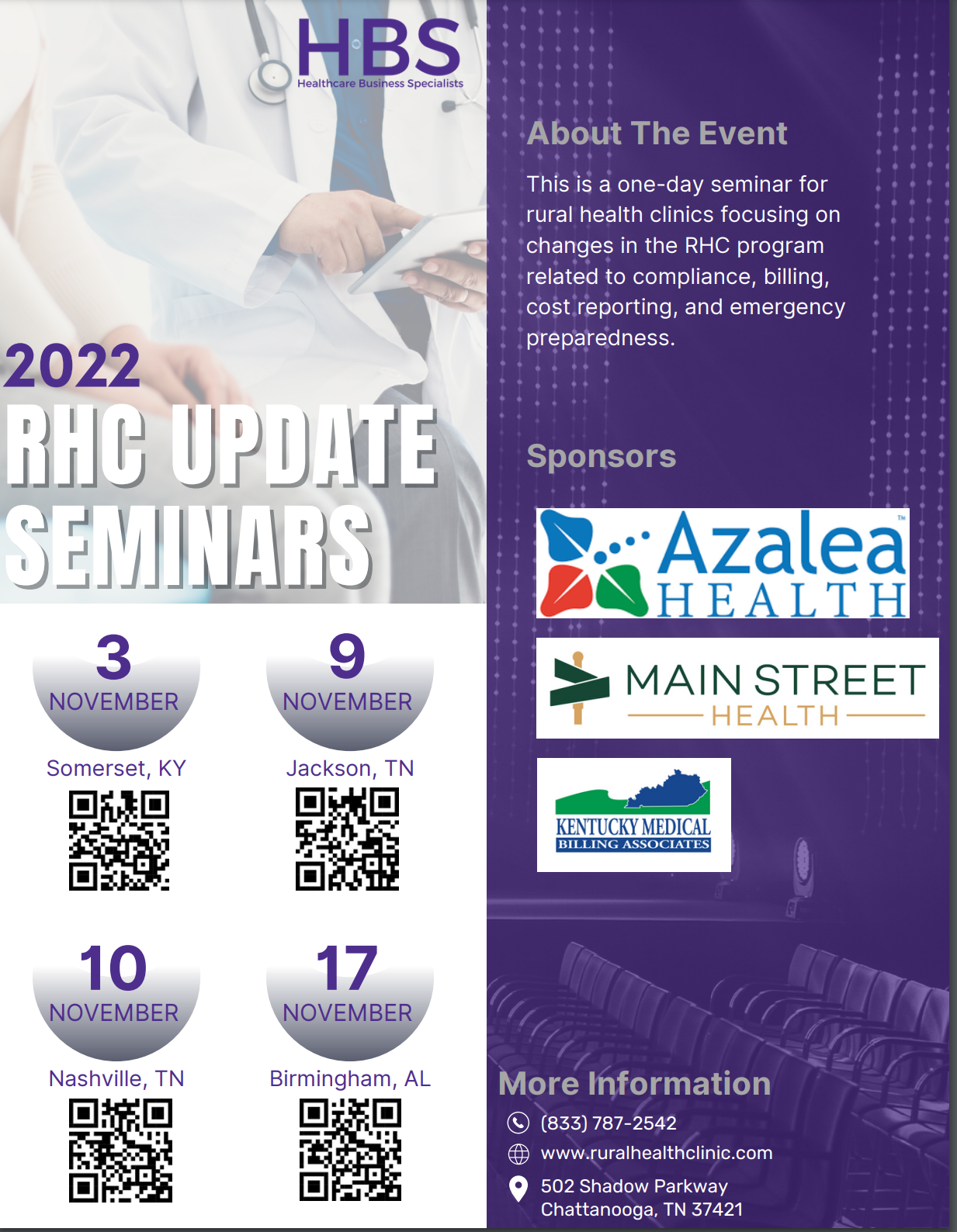
Healthcare Business Specialists is pleased to announce that the RHC Spring Update seminars have been scheduled for 2010. The dates and locations are as follows: Indianapolis on April 23, 2010, Columbia, SC on April 30, 2010, and St. Louis, MO on May 7, 2010. The seminars will be a little different than in the past. We will start at 9:30 and run until noon.  We will have a 1˝ hour break for lunch which will be on your own from Noon to 1:30 pm. The seminar will then run from 1:30 to 4:00 pm. Food will not be served at the seminars, so bring a snack.  

The price of the seminar will be $200.00 per person for the full day or $100 if you just plan on attending a half day. We offer a $25 discount for members of the same organization. The fee is $200 for the first person from the same organization and $175.00 for the second. We offer a referral bonus of $25.00 to anyone who refers an attendee to the seminar. Just have the person write the name of the referring person in the promo code section of the registration form and we will pay the referral fee at the seminar. (You must be registered for the seminar to receive a referral fee.)  The printed material including full color slides is not a part of the fee and if you want to obtain the notebook the cost is $100 per notebook. The notebook will include a diskette with all the presentations and additional information related to RHCs. Again, the notebook is an additional fee from the seminar fee and if you can not attend the seminar you can order the RHC Update Notebook or the Cost Report Notebook. Both are $100.00. 

2010

RHC Update Seminar Registration Form

Please complete the following registration information


Name


Clinic


Address (1)


Address (2)


City, State, Zip


Telephone


Fax


Email


Which Seminar are you signing up for? Please check beside the seminar that you wish to attend and check whether you want to order the Workbook and CD as well as the Seminar. The cost of the seminar is $200 and the cost of the workbook is $100. You do not have to come to the seminar to order the workbook or the cost report workbook.


Location

Date

Seminar

Workbook

Indianapolis

April 23rd


Columbia, SC

April 30th


St. Louis

May 7th


Please mail this form to Mark R. Lynn, Healthcare Business Specialists,

Suite 214, 502 Shadow Parkway, Chattanooga, TN  37421 or fax it to (800) 268-5055. Checks should be made out to HBS or you may Paypal the payment to la_vita_nouva@hotmail.com. Workbook only orders accepted.  

2010 RHC Update Seminar

Preliminary Outline of Presentation 

I.                  Legislative & Regulatory

a.     Status of Proposed Regulations changing conditions of participation issued June 27, 2008

                                                             i.      Location Requirements

1.    Grandfathering exceptions

                                                          ii.      Quality Improvement Plans

                                                       iii.      Infection control

                                                        iv.      Posting of hours

                                                           v.      Collection of charges limited to cost

                                                        vi.      Commingling

b.    Status of Proposed Legislation increasing the RHC rate to $92 per visit

c.      Electronic Medical Records Incentive Payments

d.    Red Flag Regulations

e.     Anti-markup and Stark Update

f.       Healthcare Reform in general

II.               Billing Update

a.     MAC Transition and future transitions (Cahaba, etc)

b.    IPPE and AAA Billing Instructions

c.      Diabetes and Medical Nutritional therapy

d.    Phase-out of mental health reductions

e.     Top Billing errors per Cahaba

f.       Comparison of RHC payments to RBRVS payments

g.     Payment Add-ons

h.    Exceptions to the rules

i.       CERT and RAC Contractors

j.       Medicare Advantage Plans (MA)

k.     PECOS Application

l.       RHC Billing Basics

m. RHC Billing Cheat sheet

n.    Definition of visits

o.    SNF and swing bed reimbursement

p.    Cahaba contacts and phone numbers

III.           Cost Reporting Update

a.     Filing cost reports with Cahaba

b.    P S and R Update (New system)

c.      Cabaha Cost Report Contacts and Phone numbers

d.    H1N1 Flu shot guidance

e.     Capturing information for the preparation of the cost report

f.       Rate increase to $77.76 from $76.84

g.     New physician compensation limits per visit

h.    Medicare Bad Debts and dual eligible cross over bad debts

IV.           Annual Evaluations

a.     Description of files on the CD including rural health clinic policy and procedure manual and annual evaluation template.

b.    Inactive records and how to review them

c.      Chart Audits and sample forms

d.    Why have an annual evaluation

e.     How to get the most from the annual evaluation process. 

RHC Update Seminar CD Contents 

If you are interested in the contents of our RHC Update Seminar CD this table is for you. The CD contains an archive of all the lost Riverbend files including the all important LCDs that Riverbend used. Until Cahaba develops coverage decisions specific to rural health clinics, these are an excellent billing resource. The CD will be filled with 20 years of experience in RHCs and organized in a manner that makes the information accessible. 


Section


Description or Title

File

Type


Pages

Publish Date

Certification

RHC Policy and Procedure Manual

Word

75

2009

Certification

Annual Evaluation Template

Word

15

2009

Billing

TrailBlazer UB-04 RHC Billing Examples

Adobe

15

October

2009

Billing

Trailblazer Electronic Prescribing Initiative

Adobe

8

August

2009

Billing

Cigna – Medicare Resources  - Part B

Adobe

24

2009

Cost Report

Update to the Changes to the PS&R System

PowerPoint

10

2009

Cost Report

Medicare Cost Report Changes

Powerpoint

15

2009

Billing

RHC Billing Cheat sheet

Word

4

2010

Billing

Medlearn Matters from CMS

Adobe

?

2009

Legislative

Proposed Regulations for RHCS

Adobe

?

2008

Legislative

Proposed EMR regulations

Adobe

204

2010

Billing

RHC Update Presentation

Powerpoint

?

2010

Billing

Fraud and Abuse

Powerpoint

?

2009

Cost Report

Recent Medicare Cases

Powerpoint

?

2009

Legislative

Red Flags policies and procedures

Word

20

2009

Cost Report

RHC Cost Report Workpapers

Word

?

2010

Cost Report

Physician Compensation Tables

Word

2

2010

Billing

CPT Frequency Comparison Spread..

Excel

3

2008


[1] This answer was derived from the NARHC Listserve with credit to Steve Rousso, Principal, MBA, MPA, HFS Consultants, Oakland, CA and to Brenda Caswell,CPC.

[2] Bill Finerfrock, Executive Director of the NARHC.

[3][3]Bill Finerfrock, Executive Director of the NARHC.


[4] This information is provided by the NARHC List-Serve, Bill Finerfrock, Executive Director.

[5] Assuming Cahaba GBA is your MAC.


RHC Medicare Payment limit increases to $77.76

 The RHC upper payment limit per visit is increased from $76.84 to $77.76 effective January 1, 2010, through December 31, 2010 (i.e., CY 2010). The 2010 rate reflects a 1.2 percent increase over the 2009 payment limit in accordance with the rate of increase in the Medicare Economic Index (MEI) as authorized by the Social Security Act (Section1833(f)). Here is a link to the Medlearn article implementing the payment increase:

 http://www.cms.hhs.gov/mlnmattersarticles/downloads/MM6605.pdf

 Mental Health Reduction Phase Out

 Most RHC services for the treatment of mental, psychoneurotic, and personality disorders are subject to the outpatient mental health treatment limitation (the limitation) in Section §1833 of the Act. Certain diagnostic services and brief office visits for monitoring or changing drug prescription(s) are not subject to the limitation.

 The limitation has been 62.5 percent since the inception of the Medicare Part B program and it will remain effective at this percentage amount until January 1, 2010. However, effective January 1, 2010, through January 1, 2014, the limitation will be phased out as follows:

                                    • January 1, 2010 – December 31, 2011, the limitation percentage is 68.75%.

                        • January 1, 2012 – December 31, 2012, the limitation percentage is 75%.

                        • January 1, 2013 – December 31, 2013, the limitation percentage is 81.25%.

                        • January 1, 2014 – onward, the limitation percentage is 100%.

 The mental health treatment limitation amount is applied before application of the coinsurance.

 This will increase the opportunity for RHCs to provide mental health services to the Medicare population. If you think that providing outpatient mental health services could benefit your patients please contact Dave Jolly at Solution Pointe Healthcare, LLC at dwjolly@aol.com for more information.  

Electronic Medical Records Incentive Regulations

 The Department of Health and Human Services has released the initial set of standards, implementation specifications, and certification criteria for electronic health record technology as an interim final rule on January 13, 2010.  The 35 pages of regulations can be accessed by going to the following link:

 http://edocket.access.gpo.gov/2010/pdf/E9-31216.pdf

On the same day 169 pages of proposed regulations implementing the Electronic Medical Records incentive programs were released.  To read these regulations go to:

http://edocket.access.gpo.gov/2010/pdf/E9-31217.pdf

 Both of these regulations will be summarized in our RHC Update seminar and will be available on our website; once we have completed our review of the Federal regulations.


 2010 Deductibles

The Medicare annual Part B deductible has increased from $135 in 2009 to $155 in 2010 or 14.8% per annum. At that rate, the deducible will be $1,414 in 17 years when at 67 (Social Security has moved back the eligibility dates back for baby boomers), I am eligible for Medicare. The hospital deductible which is due on every hospitalization is now $1,100 for 2010 which is a 2.9 percent increase from 2009 deductible of $1,068. Medicare is sounding more and more like private insurance every day. They also plan on cutting physician payments (Part B) by 21.2% in 2010. Medicare is sounding more and more like private insurance every day. Our premiums keep going up; but, all we get for it is a discounted fee from the medical community and the insurance company never pays anything.

September, 2009 Update


One important piece of information related to cost reports. When you start giving the swine flu injections; please keep a log just like the Medicare log for normal influenza or pneumoccocal. Please keep each of these as a separate log.

Here is the fax number for the Quarterly credit balance report for Cahaba: (205) 733-7022. Just fax the quarterly credit balance report in by the last day of the month following each quarter in order to keep your Medicare funds from being cut off.
 

6/11/2009: Here is a nice document from CMS on the certification of RHCs that I found while researching for our upcoming seminars. 

http://www.cms.hhs.gov/SurveyCertificationGenInfo/downloads/SCLetter09-14.pdf


Follow Us on Twitter

 6/09/2009: I'm on Twitter now and used it to take notes on the Cahaba conference call that was presented on June 9, 2009 at 11:00 Eastern. My notes (complete with lots of misspelled words) is included in the tweats as well as links to the websites listed in the handouts. For those of you transitioning to Cahaba on August 3rd this resource should be helpful. Here is the link:

http://twitter.com/MarkLynn34

2009 Update

As you can tell, its been a while since I have updated the website; so I wanted to update some items regarding RHCs.  The biggest item to effect RHCs is the transition from Riverbend to Cahaba as the Medicare intermediary for most RHCs. Unfortunately, this will be a stop-gap measure for most RHCs as most will transition again to another Medicare intermediary in the future.  The transition date is set for August 3, 2009 and Cahaba is requiring RHCs to submit a new 588-EFT form by July 17, 2009.  Here are a couple of links to help you get through this process:

Cahaba Transition Website
 
http://listmgr.cahabagba.com/t/630312/312048/61/0/
 

To sign up for the Cahaba listserve

http://listmgr.cahabagba.com/t/630312/312048/65/0/

To download the 588-EFT Form

https://www.cms.hhs.gov/cmsforms/downloads/CMS588.pdf

To download the "Tips for completing the 588-EFT Form

http://www.cahabagba.com/j10/CMS588_tips.pdf

Ok, not much time for the update; cost report season is in full swing here.  If you need an RHC cost report completed by the May 31, 2009 deadline give me a call at 423.243.6185.  We still have some availability; but not much. We currently are doing 40 cost reports by the 31st and have a max of 50.

Here are some forms and presentations that our clients have found helpful

                    MSP Form                                        Medicare Secondary consent form

                    RHC Policy and Procedure Manual    RHC Policy Procedure Template

                    Blank Annual Evaluation Form:        Annual Evaluation Report Template


Cost reporting           Cost Report Presentation

Annual evaluations:  Annual Evaluation Presentation


Home    About HBS     Tools    Services    RHC Seminars    Cost Reports      Search     News   Links